
When Your Nail Lamp has a Computer: The Quiet Proliferation of Embedded AI
A series of paper on AI Risk

TL;DR: A £150 nail curing lamp now ships with AI that genuinely improves performance—but also requires permanent cloud connection to its manufacturer. This pattern is repeating across thousands of product categories: real improvements bundled with ongoing manufacturer access, fundamentally changing what “ownership” means for physical infrastructure.
When Better Technology Changes More Than Performance
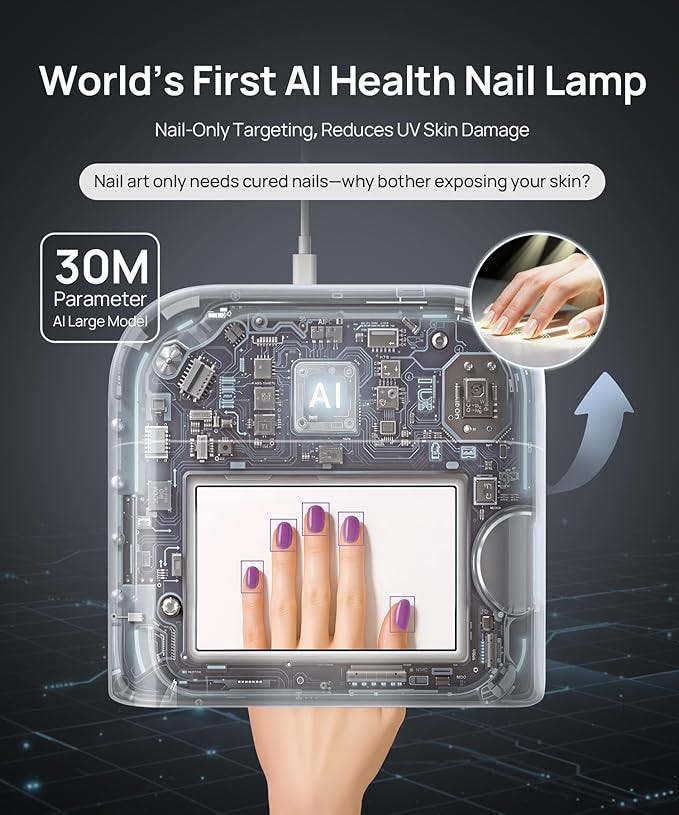
The ONAIL AI nail lamp sits in salons across the world, curing gel polish faster and more safely than traditional UV lamps. The AI detects fingernails and directs UV light only at nail surfaces, genuinely reducing skin exposure. It learns usage patterns to optimize curing times. The result: better outcomes, fewer burns, more efficient salon operations.
This is real improvement. The AI isn’t marketing gimmick—it’s solving actual problems.
Inside: a 30-million-parameter AI model, real-time video processing, cloud connectivity, and firmware that updates automatically. The manufacturer claims it gets “smarter and more intuitive” with use.
Adding new technology to old appliances is nothing new. Steam power transformed textile production. Electric motors replaced manual tools. Microprocessors made appliances programmable. Each wave brought genuine improvements. Each was adopted because the benefits were real.
But this wave is different in a fundamental way.
When electric motors replaced manual tools, the tool still belonged to its owner. When microprocessors made appliances programmable, the programs ran locally. The transaction was simple: you bought the tool, you owned it, you used it. The manufacturer’s role ended at the point of sale.
AI-embedded devices break this pattern. The improvement in performance comes bundled with something unprecedented: permanent connectivity to the manufacturer, ongoing dependencies on their cloud services, and continuous data flows back to their servers.
ONAIL has deployed approximately 100,000 devices globally (though the company claims over 4 million units shipped annually). Regardless of the exact scale, each lamp connects to the cloud, receives updates, and improves over time based on aggregated usage data—creating a distributed network of devices that collectively learn faster than any individual unit could in isolation.
When one salon discovers that certain gel types cure better at slightly different temperatures, that insight propagates to millions of other lamps within weeks. The manufacturer gains real-time visibility into how their product performs across diverse conditions. Salons benefit from continuous improvement without buying new equipment.
But the transformation runs deeper than performance. The lamp’s value increasingly comes from the network you’re connected to, not the hardware you own. Disconnect from the cloud, and the continuous improvements stop. The manufacturer isn’t just selling lamps—they’re operating computational infrastructure. Individual salons become nodes in a platform, contributing to and benefiting from collective intelligence.
It costs less than a mid-range smartphone. And it represents a fundamental shift in how AI enters everyday life.
The Pattern: Real Benefits, New Dependencies
The nail lamp is not an outlier. Across product categories, AI is delivering measurable improvements—and fundamentally changing the relationship between users and their tools.
The economics have shifted:
Computer vision models that required specialized hardware five years ago now run on $20 chips
Cloud infrastructure for model updates costs pennies per device
Manufacturing integration adds minimal marginal cost at scale
The improvements are often genuine and valued by users
Walk through a consumer electronics show and see real innovation:
Coffee makers that learn your preferences and adjust brewing parameters
Air fryers that recognize food types and optimize cooking times
Vacuum cleaners that map your home and clean more efficiently
Mirrors that track skin conditions over time
Toothbrushes that provide real-time feedback to improve technique
Door locks that recognize household members and adapt access patterns
Each solves real problems. Each provides genuine value. Users choose them because they work better.
But each also requires:
Ongoing internet connectivity
Cloud services run by the manufacturer
Continuous software updates
Data transmission to remote servers
Acceptance of terms that can change unilaterally
The bundling is the point. You can’t get the better nail lamp without also accepting permanent manufacturer access. You can’t get the smarter coffee maker without ongoing cloud dependency. The performance improvement and the infrastructure access are sold as a package.
This is historically novel. Previous waves of technological improvement didn’t require granting manufacturers permanent access to your environment as a condition of getting the better tool.
Why This Matters: Structural Shifts Across Multiple Dimensions
Regulatory Frameworks Built for Static Products
Traditional product safety frameworks assume devices are static. A toaster certified safe on Tuesday remains the same toaster on Friday.
AI-embedded devices break this assumption. The ONAIL lamp that passes CE marking today can receive a firmware update tomorrow that fundamentally alters its behavior—including safety-critical functions like UV exposure timing and intensity.
This creates unresolved questions:
Does each firmware update require recertification? (If yes, innovation bottlenecks. If no, safety gaps emerge.)
When an AI lamp causes harm, who’s liable? Hardware manufacturer? AI model developer? Firmware engineer? Cloud service provider? Salon owner?
Which jurisdiction governs a device manufactured in China, sold globally, updated from servers in multiple jurisdictions, and operated locally?
The deeper problem is scale. Regulators aren’t asked to regulate “AI”—they’re asked to regulate AI in nail lamps, in insulin pumps (medical safety), baby monitors and toys (child safety, data from minors), door locks (physical security), etc.. Each category requires different expertise, crosses different regulatory domains, and updates continuously.
Multiply this across every product category being “smartified,” and the regulatory burden becomes unmanageable using current frameworks designed for static products.
Who Should Care About this
Individual salon owners and their customers largely don’t care about data collection from nail lamps. The lamp works better, that’s what matters.
But several other parties have significant stakes:
Competitors face asymmetric information. ONAIL knows which markets are growing, which services are trending, what pricing strategies work—across 110 countries in real-time. Traditional competitors operating without this intelligence are flying blind by comparison. The data advantage compounds: better market intelligence → better product decisions → larger market share → more data.
Market entrants face insurmountable barriers. You can’t build a competitive AI nail lamp without deployment-scale data. ONAIL has at least 100,000 units learning from diverse real-world conditions. The hardware is commoditized, but the training data creates a moat. This pattern repeats across every AI device category—first movers with manufacturing scale establish data advantages that become nearly impossible to overcome.
Regulators face novel challenges. Traditional frameworks assume you can inspect a product and certify it. But these devices mutate through updates. The ONAIL lamp certified today could behave completely differently tomorrow after a firmware push. Multiply this across thousands of product categories, each with different risk profiles, each updating continuously. How do you regulate products that are fundamentally mutable?
States confront sovereignty questions. When Chinese manufacturers have cameras and network connectivity in millions of Western homes, businesses, and government facilities—with all data flowing to servers potentially under Chinese jurisdiction—this creates infrastructure dependencies that weren’t part of traditional trade relationships. The individual devices are innocuous. The aggregate network is significant.
The broader industry ecosystem shifts. The manufacturer now has privileged insight into salon operations, demand patterns, and market dynamics. This intelligence could inform vertical integration decisions, direct-to-consumer strategies, or market intelligence products sold to suppliers and investors. None of this was part of the original value proposition (”buy a better lamp”), but all of it becomes possible once you’ve installed millions of connected sensors in professional environments.
The Manufacturing Geography and Market Dynamics
The device is technically sophisticated (30M-parameter AI model, real-time video processing) yet competitively priced. Chinese manufacturers leverage cost structure and integration speed to deploy AI-embedded devices at scale before Western competitors can match on price. By the time regulatory frameworks catch up, the installed base is already massive.
But manufacturing scale now creates advantages beyond just cost:
The Data Flywheel and Market Concentration
Traditional appliances generated no data. Competition was about hardware quality, brand, and price.
AI-embedded appliances generate data continuously, creating a compounding advantage:
Phase 1 (Deployment): Device ships with baseline AI model trained on lab data and early deployments.
Phase 2 (Collection): Millions of devices generate usage telemetry—edge cases, failure modes, environmental variations that lab testing missed.
Phase 3 (Improvement): Aggregated data trains improved models. Firmware updates push better AI to the installed base.
Phase 4 (Differentiation): Devices with richer training data outperform competitors. Performance gap widens.
Phase 5 (Lock-in): Users invested in continuously-improving ecosystems resist switching to competitors with less mature models.
Phase 6 (Market concentration): Product categories consolidate around 2-3 dominant platforms with data advantages.
This creates barriers to entry that didn’t exist in traditional manufacturing. The data moat becomes nearly impossible to cross without similar deployment scale.
The strategic implication: First movers with manufacturing advantages in the AI era don’t just capture market share—they establish data positions that become self-reinforcing. Markets that were previously competitive (multiple viable players in nail lamps, vacuum cleaners, door locks) risk consolidating around whoever deploys at scale first.
This pattern is already visible in consumer robotics, where Chinese manufacturers captured 80%+ market share not through superior hardware alone, but through deployment-scale data advantages that Western competitors struggle to match.
What This Reveals About Power and Control
The Sovereignty Question
When a Chinese manufacturer has ongoing access to millions of devices operating in homes and businesses—devices with cameras and network connectivity, all data flowing to servers potentially under Chinese jurisdiction—questions of digital sovereignty arise that current frameworks weren’t built to handle.
This is present reality: 100,000+ ONAIL lamps, each with a camera, each connected to manufacturer-controlled cloud infrastructure, each updatable remotely. Multiply this across every AI device category—door locks, cameras, appliances, medical devices—and the question becomes acute: Who actually controls the physical infrastructure installed in our environments?
The answer increasingly is: whoever manufactured it, regardless of jurisdiction.
What Comes Next
The ONAIL nail lamp is remarkable because it’s unremarkable. A £150 appliance in a beauty salon with more AI capability than most enterprises had five years ago. This is the new baseline—for everything.
Within five years, the assumption that ordinary objects are self-contained and owned outright will seem quaint. We’re not debating whether devices should connect to the cloud—we’re debating who controls that cloud and what they do with the data.
The deeper shift: we’re installing infrastructure, not buying products. Every AI-embedded device is a node in a network controlled by whoever manufactured it. This happens through millions of independent purchasing decisions—each individually rational, collectively constructing computational infrastructure in every physical space, controlled not by the people who occupy those spaces, but by the companies who manufactured the objects within them.
The governance gap is structural, not temporary. Deployment moves faster than regulation by design. By the time frameworks emerge, billions of devices will be installed, dependencies entrenched, infrastructure topology set.
The nail lamp is one of many. Multiply that across every object category, every manufacturer, every environment. That’s what’s being built right now—an ambient computational infrastructure layer controlled by whoever can manufacture at scale and deploy first.
The question isn’t whether AI becomes ubiquitous—it already is. The question is whether the infrastructure of ubiquitous intelligence serves the people who live with it, or the people who manufactured it.